
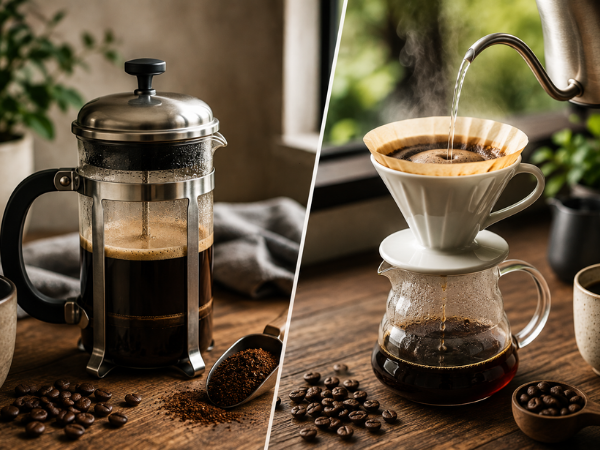
French press and pour over are two of the most popular manual coffee brewing methods, but they produce noticeably different cups. The main difference is how the coffee grounds interact with water and how the finished brew is filtered. A French press uses immersion brewing, while pour over relies on water passing through the grounds and a filter.
The result is not simply a choice between a “strong” and a “weak” coffee. French press generally produces a fuller-bodied cup with more oils and fine particles, while pour over typically delivers a cleaner and more transparent cup. Brewing technique, coffee beans, grind size, water temperature, and brew time can also change the final result.
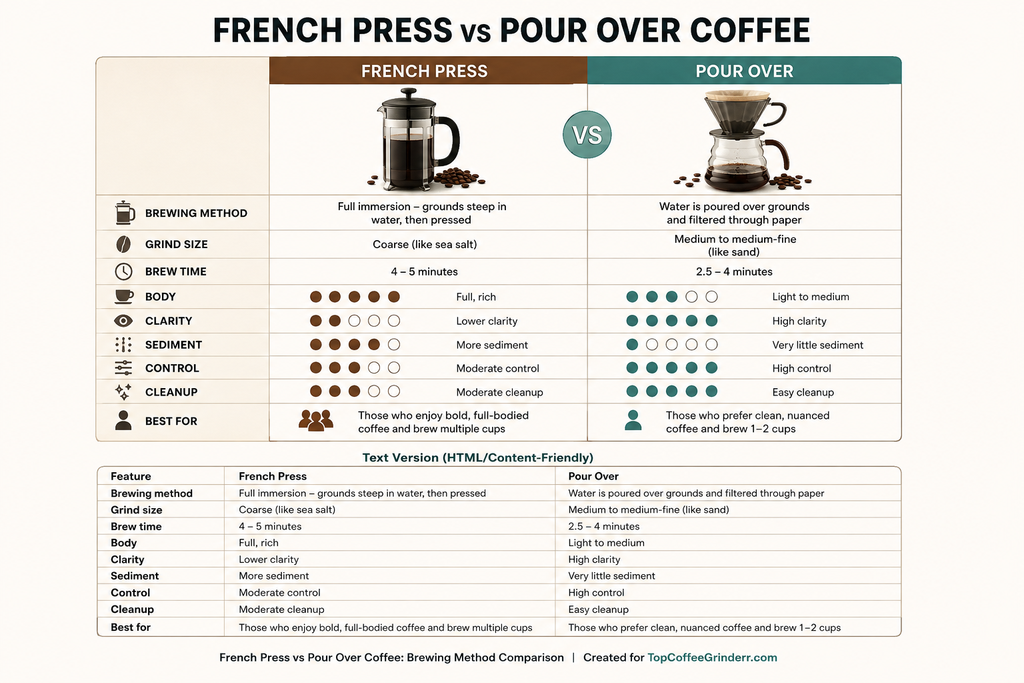
1. How French Press Brewing Works
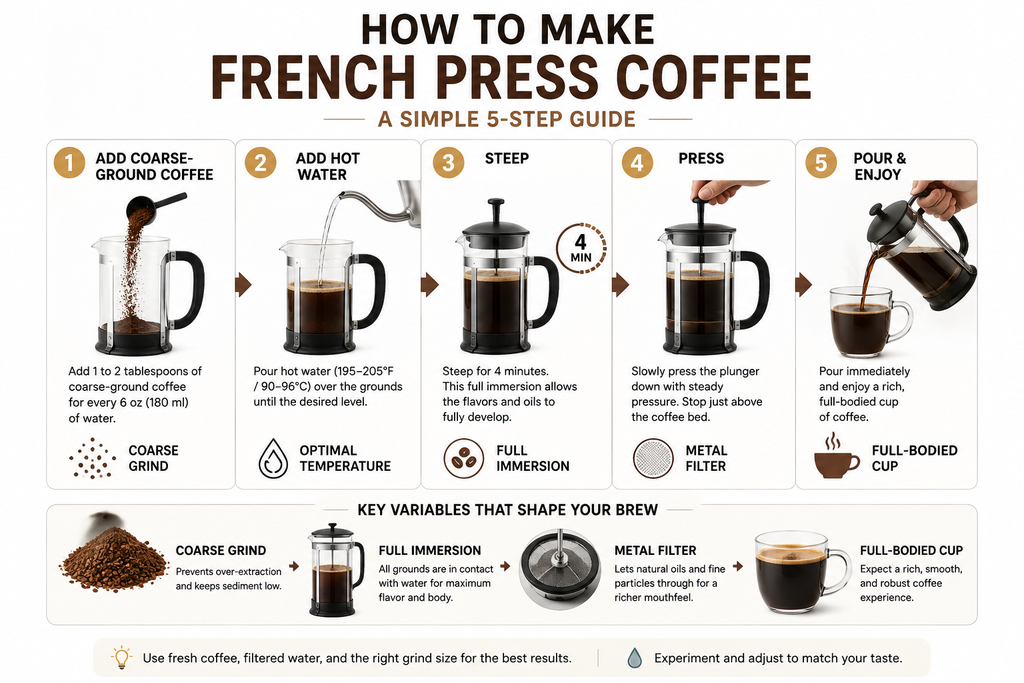
A French press is an immersion brewer. Instead of water flowing continuously through a bed of coffee grounds, the grounds remain submerged in the water for most of the brewing process.
To brew, coarse-ground coffee is placed in the carafe and combined with hot water. The grounds steep for several minutes before the plunger is pressed down. A metal mesh filter separates most of the grounds from the finished coffee and allows naturally occurring coffee oils and very fine particles to remain in the cup.
This brewing process is responsible for much of the French press’s characteristic texture. Because the filter does not remove coffee oils as thoroughly as a paper filter, the drink usually feels heavier and more substantial.
What Makes French Press Coffee Different?
The immersion process gives you relatively straightforward control over several variables. You can adjust the coffee-to-water ratio, steeping time, grind size, and water temperature to change the strength and extraction of the brew.
A coarse grind is generally preferred because very fine grounds can pass through the metal filter and make the coffee excessively muddy. Overly fine coffee can also make pressing the plunger more difficult.
French press brewing is particularly appealing when you want a rich cup without complicated equipment. It can also be practical when making multiple servings at once.
2. How Pour Over Brewing Works
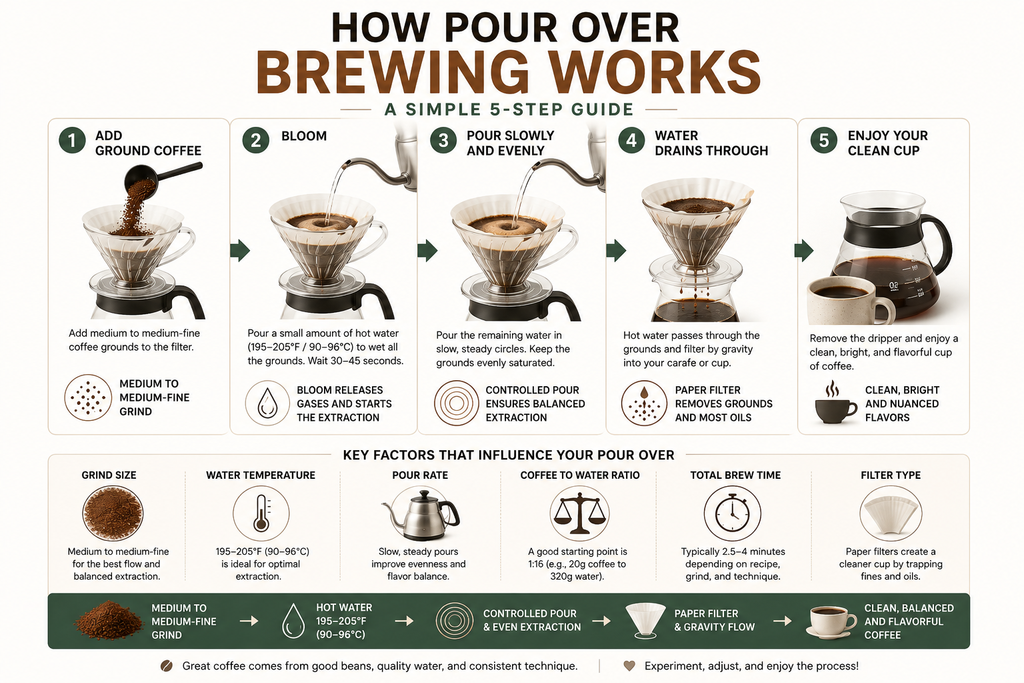
Pour over coffee uses a different approach. Ground coffee sits inside a filter, and hot water is poured over it. Gravity moves the water through the coffee bed and into a carafe or cup below.
Paper filters remove most coffee grounds and a significant amount of coffee oils, producing a cleaner cup than a typical French press. The filter also makes it easier to distinguish individual flavor characteristics in the coffee.
The brewer has more influence over the extraction because water is introduced gradually rather than all at once. Pouring speed, water distribution, grind size, total brew time, and the shape of the coffee bed can all affect the finished cup.
Why Pour Over Requires More Technique
Pour over brewing can be simple, but consistently excellent results usually require some practice. The way you pour water matters.
A controlled pour helps keep the coffee bed evenly saturated and reduces the risk of water finding an easy path around the grounds. Many brewers divide the water into several pours rather than adding it all at once.
This additional control is one reason pour over is popular with people who enjoy experimenting with different coffees and brewing recipes.
3. Taste, Body, and Coffee Clarity
The most noticeable difference between the two methods is often found in the cup itself.
French Press: Fuller Body and More Texture
French press coffee tends to have a heavier mouthfeel. The metal filter permits more oils and tiny coffee particles to remain in the beverage, creating a richer texture.
This does not automatically mean that French press coffee has more caffeine or is inherently stronger. “Strength” can refer to several things, including concentration, bitterness, body, or simply how intense the coffee tastes.
French press can work especially well with coffees where a fuller body and rounded flavor are desirable.
Pour Over: Cleaner and More Defined
Pour over coffee is generally clearer because the filter removes most of the sediment and many of the oils. This gives the coffee a lighter mouthfeel and can make subtle flavor differences easier to notice.
A well-brewed pour over can highlight acidity, sweetness, fruit-like notes, floral aromas, and other characteristics that may be less obvious in a heavier brewing method.
However, pour over is not automatically better tasting. If you prefer a thick, rich cup, its cleaner texture may actually feel less satisfying.
Which Has More Flavor?
Neither method simply has “more flavor.” They emphasize different characteristics.
French press tends to emphasize body, richness, and texture, while pour over often emphasizes clarity, aroma, and distinct flavor notes.
The coffee itself matters just as much. High-quality beans can taste excellent with either method when the recipe is properly adjusted.
4. Brewing Time, Grind Size, and Control
Grind size and brewing time play an important role in both methods, but they work differently. French press relies on immersion, while pour over depends on the flow of water through the coffee bed.
| Brewing Factor | French Press | Pour Over |
|---|---|---|
| Grind Size | Coarse | Medium to medium-fine |
| Typical Brew Time | About 4 minutes | About 2.5–4 minutes |
| Brewing Process | Coffee grounds steep fully in water | Water passes through the coffee grounds |
| Brewing Control | Moderate | High |
| Key Variables | Grind size, coffee-to-water ratio, water temperature, steeping time | Grind size, coffee-to-water ratio, water temperature, pouring technique, brew time |
| Filter | Metal mesh | Usually paper |
| Typical Cup | Full-bodied with more oils and fine particles | Cleaner with less sediment |
Grind size: French press generally calls for a coarse grind, while pour over usually works with a finer grind. The ideal setting can vary depending on the brewer, filter, coffee, and recipe.
Brewing time: Around four minutes is a common starting point for French press. Pour over often takes roughly 2.5–4 minutes, although the target time varies by recipe and equipment.
Control: Pour over gives you more direct control over water flow and saturation. French press is more straightforward because the grounds remain immersed during the brewing stage.
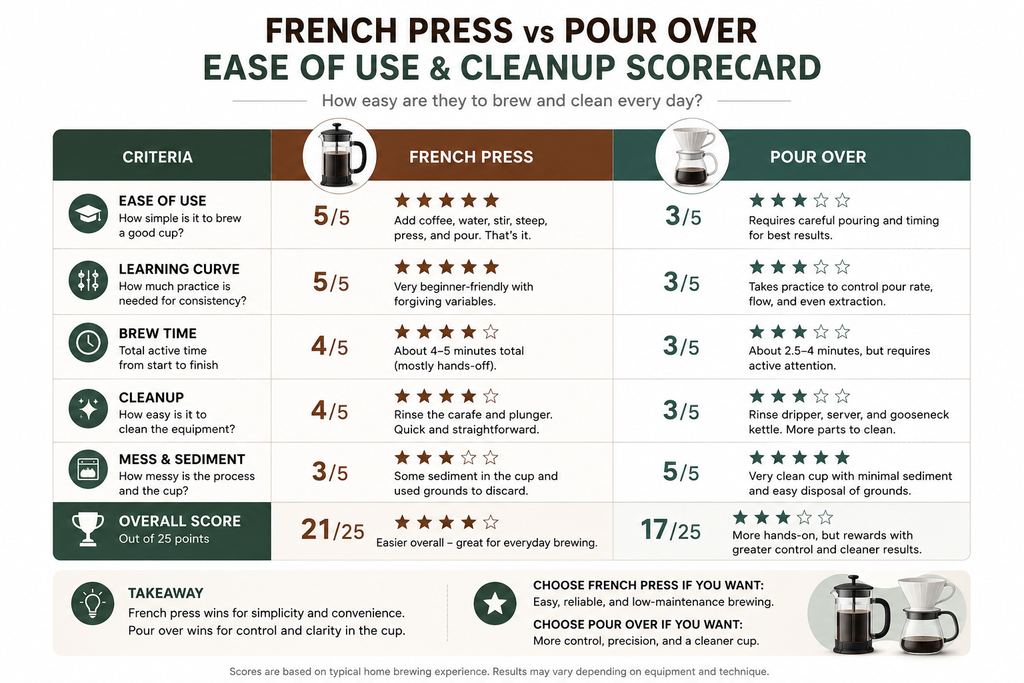
5. Which Method Is Easier to Use and Clean?
For everyday brewing, convenience can be just as important as flavor.
French Press Cleanup
French press cleanup involves removing the used coffee grounds, emptying the carafe, and rinsing the filter and brewing vessel. The grounds can be messy, especially if they are dumped directly into a sink.
The metal filter is reusable, so there is no paper filter to discard after every brew. However, the mesh should be rinsed thoroughly because coffee oils and fine particles can accumulate over time.
Pour Over Cleanup
Pour over cleanup is usually straightforward. After brewing, the used paper filter and coffee grounds can be removed together and discarded or composted where appropriate.
The brewer itself generally needs only a rinse, although reusable metal or cloth filters may require additional cleaning.
The trade-off is that pour over creates an ongoing need for filters unless you use a reusable alternative.
Which Is More Convenient?
For many people, pour over has the easier cleanup process because the filter keeps most of the grounds contained. French press avoids disposable filters but can require more work to remove the grounds and clean the mesh.
6. Which Coffee Maker Is Better for Beginners?
Both methods are suitable for beginners, but they appeal to different types of new coffee brewers.
A French press is often easier to learn because the basic process is uncomplicated: add coffee, add water, steep, and press. You do not need to master a particular pouring technique to make a drinkable cup.
Pour over has a slightly steeper learning curve. Small changes in pouring speed, grind size, and water distribution can noticeably affect the result.
That does not mean pour over is difficult. Once you establish a reliable recipe, the process becomes repeatable. It simply offers more opportunities to adjust the brew.
Best Starting Point
Choose a French press if you want:
- A simple brewing routine
- A fuller-bodied cup
- Minimal equipment
- No disposable paper filters
- Coffee for more than one person
Choose pour over if you want:
- A cleaner cup
- More control over extraction
- Easy cleanup with paper filters
- A brewing method suited to one or two cups
- More emphasis on delicate coffee flavors
7. How to Choose the Right Brewing Method for You
The best brewing method should match your taste preferences and daily routine rather than a general claim that one technique is superior.
Choose French Press If You Prefer Rich, Full-Bodied Coffee
French press is a strong option for people who enjoy a heavier mouthfeel and noticeable coffee oils. It is also convenient when you want to brew several cups without spending a lot of time on manual pouring.
It can be particularly appealing if you prefer a simple process with fewer brewing variables.
Choose Pour Over If You Prefer Clean, Detailed Coffee
Pour over is better suited to drinkers who value clarity and want to explore the characteristics of different beans. The paper filter creates a cleaner cup, while the brewing process gives you considerable control over extraction.
It is also a natural choice if you typically make one or two cups at a time.
Consider Your Coffee Routine
Your schedule matters, too.
If you want to prepare coffee with minimal attention, French press may fit your routine better. If you enjoy the brewing ritual and don’t mind spending a few extra minutes controlling the pour, pour over can be more rewarding.
There is also no reason to choose only one. Many coffee drinkers keep both methods and use them for different beans, occasions, or moods.
Is French press coffee stronger than pour over?
Not necessarily. French press often tastes stronger because it has a fuller body, but caffeine content depends on the recipe, coffee amount, and serving size.
Which tastes better, French press or pour over?
It depends on your preference. French press produces a richer, heavier cup, while pour over offers a cleaner and more nuanced flavor.
Can you use the same coffee beans for both methods?
Yes. You can use the same beans for both methods, but adjust the grind size and brewing recipe for each one.